Home › Portfolio › Backyard Turf in Vancouver, WA
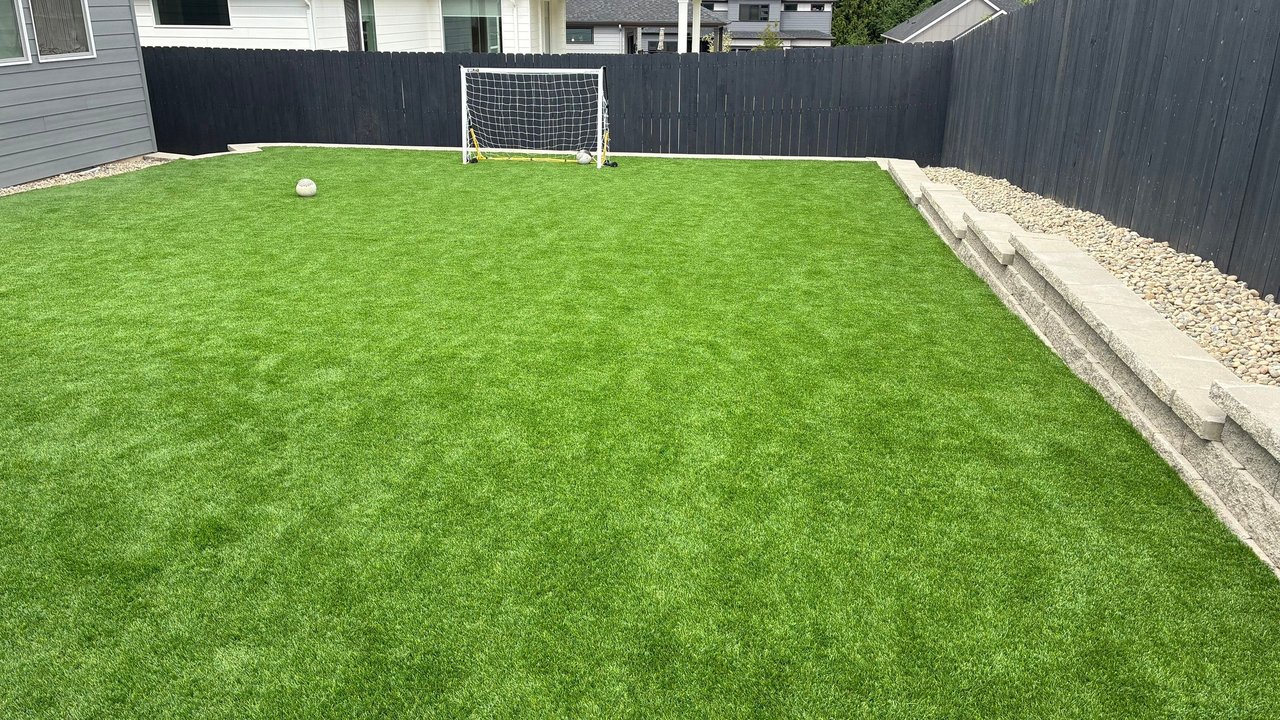
Sta-Built Construction turned the bare graded dirt behind a newly built Vancouver, WA home into 2,099 square feet of SB-RealFeel synthetic turf, wrapped on three sides by a river rock band and edged with block along the fence line. The turf field runs about 77 feet by 33 feet and steps around the existing concrete patio. Every yard of material reached the backyard through a side yard with 36 inches of clearance. The job closed in June 2026.
Project Details
- Location: Vancouver, WA
- Service: Synthetic turf installation with a river rock perimeter
- Turf area: 2,099 sq ft
- Field dimensions: about 76 ft 10 in by 33 ft 4 in, stepped around a 15 ft by 13 ft concrete patio
- Turf product: SB-RealFeel, 2K-volume specification
- River rock: 1 1/2 inch river rock, 4 inches deep over weed block fabric; 579 sq ft in the work order, expanded by change order to about 844 sq ft
- Base construction: excavate down 4 inches, 3.5 to 4 inches of crushed rock compacted, woven geotextile fabric over the base
- Seaming: Super Seam Method with seam tape and turf adhesive
- Fastening: rust-in-lock turf nails, minimum every 12 inches around all edges
- Infill: Premier Green at 1.5 lbs per sq ft, power broomed
- Site access: 36 inches of clearance through the side yard, no machine access to the backyard
- Completed: June 2026
- Project investment range: $29,200 to $45,900
- Warranty: 17-Year Craftsmanship Warranty
Before and after

The problem
This is the condition most new-construction homes are handed over in. Photos from the February 2026 site visit show a backyard of bare graded fill, rutted from equipment, with scrap lumber still on the ground and the covered patio posts just framed. The lot is large and flat, the fence is already up, and there is nothing else: no lawn, no planting beds, no drainage detail where the ground meets the fence.
The practical problem with a yard this size on builder fill is that it stays mud for a season and then grows an uneven lawn, because builder grading is done for drainage away from the foundation, not for a finished surface. The other problem is access. The house is close to both property lines, and the only route from the driveway to the backyard is a side yard with 36 inches of clear width.
The solution
The design covers essentially the whole usable yard in turf: a field about 76 feet 10 inches by 33 feet 4 inches, stepped around the 15 foot by 13 foot concrete patio so the turf meets the slab on two sides. Around the outside, against the fence on three sides, a band of 1 1/2 inch river rock 4 inches deep over weed block fabric, continuing up the side yard to the shed area.
The rock band is not decoration. On a flat lot where the turf runs all the way to a solid fence, the perimeter is where water collects and where trimmer damage and weed growth start. A rock band over fabric gives the turf edge a hard stop, a place for perimeter water to sit and drain, and a maintenance strip that never has to be cut. The river rock scope grew during the job by change order, from the 579 square feet on the original work order to roughly 844 square feet.
Along the fence line the crew set a low block edge before the turf went down, which holds the line between the turf base and the rock band and keeps the two materials from migrating into each other.
The materials
The turf is SB-RealFeel, installed to the work order’s 2K-volume synthetic turf specification. The material order cut it into six rolls sized to the field, one at 35 feet and five at 32 feet, so the seams run the short way across the yard rather than down its length.
The rest of the system is seam tape and 28-ounce tubes of turf adhesive for the Super Seam Method, 50-pound boxes of rust-in-lock turf nails for the perimeter fastening, and Premier Green infill, which the work order specifies at 1.5 pounds per square foot. The perimeter band is 1 1/2 inch river rock over weed block fabric.
How it was built
The block edge and the perimeter work went in at the end of March 2026, while the house was still being finished. The base and the turf followed in June, once the builder was off the site.

The work order calls for excavating down 4 inches, installing 3.5 to 4 inches of crushed rock and compacting it, then laying woven geotextile fabric over the finished base. On builder fill that base course is doing double duty: it gives the turf a flat plane to sit on, and it puts a compacted, free-draining layer between the turf and ground that was never compacted for a finished surface.
Everything crossed the 36-inch side yard. Roughly 2,100 square feet of base rock at 4 inches deep, six rolls of turf, the block for the edge, the river rock and the infill all moved through that gap by wheelbarrow and by hand, because no machine fits. That constraint was identified at the site walk and photographed for the crew, and it is the single biggest reason a yard this size took the crew the better part of two weeks rather than a few days.
Turf went down the week of June 10 and was finished by June 17. The rolls were joined with the Super Seam Method, seam tape and adhesive under the joint rather than a surface stitch, nailed at a minimum of every 12 inches around all edges, cut in to the patio slab and the rock band, infilled at 1.5 pounds per square foot and power broomed.
The finished result

The yard went from bare builder fill to a single flat green surface running fence to fence, with room for a soccer goal and space to play around it. The concrete patio sits inside the turf field rather than at the edge of it, and the river rock band draws the boundary at the fence line on three sides. Final photos were taken June 17, 2026.
What a project like this costs
Project investment range: $29,200 to $45,900. This range reflects the scope of this completed project and is not a current quote.
Square footage is the obvious driver, and 2,099 square feet is a large residential turf install. But the two things that separate this project from a same-sized turf job on an open lot are access and base volume. Access first: with 36 inches of side yard clearance, nothing can be machine-fed, so the labor line reflects hand-moving roughly 2,100 square feet of base rock, six rolls of turf, block and river rock through a gap narrower than a wheelbarrow is long.
Base volume second: 4 inches of excavation and 3.5 to 4 inches of compacted crushed rock across a field this size is a significant material and disposal cost before any turf is unrolled. The river rock perimeter added to the total as well, growing by change order from 579 to roughly 844 square feet during the build.
See more on our artificial turf page. We install turf across Clark County from our Vancouver service area. Related Vancouver project: a 617 square foot turf lawn in a shaded, root-bound backyard.
Related questions
What does 2,000 square feet of artificial turf cost in Vancouver, WA?
This 2,099 square foot yard, including the compacted base, a river rock perimeter band and a block edge along the fence, came in between $29,200 and $45,900. A yard the same size with machine access and no perimeter work would sit lower, because on this project every yard of material moved by hand through a 36-inch side yard.
Is artificial turf a good fit for a new-construction yard?
It addresses a specific problem with builder lots: the ground is graded for drainage away from the foundation, not compacted or leveled for a finished surface, so a seeded lawn on top of it tends to come in uneven. Excavating 4 inches and compacting a crushed rock base establishes a flat, free-draining plane first, and the turf goes on that rather than on the fill.
Why put river rock around the edge of a turf lawn?
On a flat lot where turf runs to a solid fence, the perimeter is where water collects and where weeds and trimmer damage start. A band of 1 1/2 inch river rock 4 inches deep over weed block fabric gives the turf edge a hard stop, a drainage strip at the fence line, and a maintenance edge that never needs cutting. On this project the band runs along three sides and continues up the side yard.
Can a large turf yard be installed with no machine access?
Yes, but it changes the schedule and the price. This backyard was reachable only through a side yard with 36 inches of clear width. All of the base rock, turf, block and river rock moved by wheelbarrow and by hand, which is the main reason a yard of this size took the crew the better part of two weeks. Access is worth identifying at the site walk, not on the first day of work.
Does Sta-Built install artificial turf in Vancouver?
Yes. This project is in Vancouver, WA, and Sta-Built installs synthetic turf lawns, pet turf and putting greens across Clark County from the Vancouver showroom on East 4th Street. Washington license: STABUL*782LN.
Planning something similar?
If a builder handed you a yard of bare fill and you would rather not spend two seasons fighting a lawn into it, Sta-Built can walk the lot, check the access and lay out what the base and the turf would take. Schedule a free design consultation.
This project documentation was prepared by Sta-Built Construction from the project records and photos from our crew, September 2026. Technical review by Ben Metsker, Manager.